


 |
Pat Brown
Dr. Brown's research group uses diverse experimental and computational methods to investigate the logic and mechanisms that control a genome's expression program. The Brown laboratory is systematically characterizing the genetic scripts that control the expression of our genes, in normal development and physiology and in diseases like cancer, with a particular focus on post-transcriptional regulation. The Brown lab also develops strategies and assays for early detection and diagnosis of cancer. |
||||||||
 |
Gil Chu Joint with Department of Medicine Our laboratory studies how cells respond to damaged DNA. We focus on pathways for the repair of UV-damaged DNA and the repair of DNA double-strand breaks induced by ionizing radiation and V(D)J recombination, the mechanism that generates immunological diversity. In the hope of imporving cancer treatment and prevention, we use microarrays to study transcriptional responses to DNA damage in cancer patients.
|
||||||||
 |
Rhiju Das Rhiju Das strives to predict how sequence codes for structure in proteins, nucleic acids, and heteropolymers whose folds have yet to be explored. The Das group uses new computational and experimental tools to tackle the de novo modeling of protein and RNA folds, the high-throughput structure mapping of riboswitches and random RNAs, and the design of self-knotting and self-crystallizing nucleic acids.  |
||||||||
 |
Ron Davis We are using Saccharomyces cerevisiae and Human to conduct whole genome analysis projects. The yeast genome sequence has approximately 6,000 genes. We have made a set of haploid and diploid strains (21,000) containing a complete deletion of each gene. In order to facilitate whole genome analysis each deletion is molecularly tagged with a unique 20-mer DNA sequence. This sequence acts as a molecular bar code and makes it easy to identify the presence of each deletion. |
||||||||
 |
James Ferrell Joint with Department of Chemical and Systems Biology We have been studying the system of regulatory proteins that drives the cell cycle, through a combination of quantitative experimental approaches, computational modeling, and the theory of nonlinear dynamics. Our goal is to understand the design principles of this system, and perhaps to gain insight into the systems that drive other biological oscillations (e.g. heart beats, calcium oscillations, circadian rhythms) as well.
|
||||||||
 |
Pehr Harbury Our lab engineers proteins and small-molecule drugs at atomic resolution through a combination of structural calculations and combinatorial library synthesis. Our goal is to elucidate predictive principles by which novel shapes and catalytic properties can be conferred accurately on designed polypeptides. Website Coming Soon! |
||||||||
 |
Dan Herschlag Our research is aimed at understanding the chemical and physical behavior underlying biological macromolecules and systems, as these behaviors define the capabilities and limitations of biology. Toward this end we study folding and catalysis by RNA, as well as catalysis by protein enzymes. |
||||||||
 |
KC Huang Joint with Bioengineering Our group employs diverse interdisciplinary methods of inquiry to understand the relationships among cell shape detection, determination, and maintenance in bacteria. We utilize a combination of analytical, computational, and experiemental appraoches to probe physical mechanisms of shape-related self-organization in protein networks, membranes, and the cell wall. Current topics of interest are the regulation and mechanics of bacterial cell division, membrane organization, the structure and synthesis dynamics of the cell wall, cell cycle regulation, and multicellular behavior.
|
||||||||
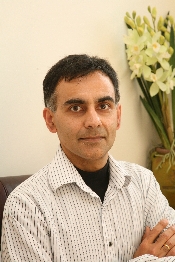 |
Chaitan Khosla Joint with Chemical Engineering Research interests in the laboratory lie at the interface of chemistry and medicine. For the past several years, we have investigated the catalytic mechanisms of modular megasynthases such as polyketides synthases, with the concomitant of harnessing their programmable chemistry for preparing new antibiotics. More recently, we have investigated the pathogenesis of celiac sprue, an HLA-DQ2 associated autoimmune disease of the small intestine.
|
||||||||
 |
Mark Krasnow Genetic and molecular basis of respiratory system development, maintenance, and disease in Drosophila, mouse, and human. |
||||||||
 |
Sharon Long Joint with Biology Our laboratory studies the early stages of symbiosis between Rhizobium (also Sinorhizobium) meliloti and and its host plants in the genus Medicago. The symbiosis is uniquely approachable by experiment because each partner can be genetically manipulated, and transgenic organs can be constructed, allowing highly specific genetic tests of various components of signal and response. We use genetics, biochemistry and cell biological approaches to study how cell division, growth, and gene expression arise in each partner due to stimulation from the other.
|
||||||||
 |
Suzanne Pfeffer The goal of our research is to elucidate the molecular mechanisms by which proteins are targeted to specific membrane compartments. How do transport vesicles select their contents, bud, translocate through the cytoplasm, and then fuse with their targets? We study the Ras-like Rab GTPases--how they are localized to distinct intracellular compartments in human cells, and how they serve as master regulators of all receptor trafficking events. |
||||||||
 |
Rajat Rohatgi Joint with Medicine We are working to elucidate the biochemical and cell biological principles that govern signaling pathways that sit at the intersection between developmental biology and cancer. Our toolkit combines bulk biochemical techniques, such as cell-free reconstitution, witih microscopy using novel optical probes to study the dynamics of signal propogation in cells. We strive to develop novel strategies for the manipulation of these pathways for cancer therapies and applications in regenerative medicine.
|
||||||||
 |
James Spudich The general research interest of this laboratory is the molecular basis of cell motility. We have three specific research interests, the molecular basis of energy transduction that leads to ATP-driven myosin movement on actin, the biochemical basis of the regulation of actin and myosin interaction and their assembly states, and the roles these proteins play in vivo, in cell movement and changes in cell shape. |
||||||||
 |
Aaron Straight We study the process of cell division. Our research is focused on understanding how chromosomes are segregated during mitosis and how cells divide during cytokinesis. |
||||||||
 |
Julie Theriot We study the interactions between infectious bacteria and the human host cell actin cytoskeleton. Listeria monocytogenes and Shigella flexneri are unrelated food-borne bacterial pathogens that share a common mechanism of invasion and actin-dependent intercellular spread in epithelial cells. Our studies fall into three broad areas: the biochemical basis of actin-based motility by these bacteria, the biophysical mechanism of force generation, and the evolutionary origin of pathogenesis.
|
||||||||
|

|
||||||||


 |
 |
 |
 |
 |
 |
 |
 |