The People, History and Facilities of the Department of Developmental
Biology at Stanford
The Department was founded in 1989 in recognition of the explosive growth
in understanding the molecular biology of development, and in recognition
of its potential impact on modern medical practice.
The field of developmental biology is fundamentally integrative. In trying
to understand how cells coordinate their activities to form a working organism
we employ genetics, genomics, imaging, biochemistry, transgenesis, injection,
optical tweezers, clinical studies, and especially that most powerful approach
of all: discussion. The Department includes fourteen laboratory groups,
most of them in the Beckman Center building.
The Department is home to about 60 graduate students and 80 postdoctoral
fellows. These people are the key to the Department's success; they take
the research in new directions, debate approaches and ideas, and bring
an enormous amount of wisdom and experience to the labs.
We
also have a superb financial, administrative, and scientific staff that
keeps the
Department running smoothly. In order to promote learning and transfer
of experience
and expertise, all facilities and instruments are shared and many of
the department rooms contain a mixture of people from different labs.
Interactions between the laboratories and departments are promoted by
joint departmental recreation events, such as the DB/genetics baseball
game shown below. 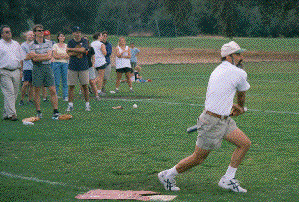 The
Department is amply equipped with modern equipment such as confocal
and
other types
of microscopes, microarray facilities, robotics, and computer systems.
Within our building are microchemical and sequencing facilities, an imaging
center that has numerous microscopes and offers courses in their use,
an extensive animal facility, a cell sorter facility run by the people
who
invented cell sorters, and a new electron microscope facility under construction
that is to be run by our department. A major new center for Mass Spectrometry
is partly operational and is about to be greatly expanded. The
Department is amply equipped with modern equipment such as confocal
and
other types
of microscopes, microarray facilities, robotics, and computer systems.
Within our building are microchemical and sequencing facilities, an imaging
center that has numerous microscopes and offers courses in their use,
an extensive animal facility, a cell sorter facility run by the people
who
invented cell sorters, and a new electron microscope facility under construction
that is to be run by our department. A major new center for Mass Spectrometry
is partly operational and is about to be greatly expanded.
|
We are within minutes of about fifty other Stanford labs that collectively form
the developmental biology community at Stanford. Close contact and friendship
among the labs within the department and in other departments are promoted
by frequent shared events. Each year we hold a Department retreat, usually
at a conference center at Monterey Bay (Asilomar) or in the Sierra Nevada mountains.
 There
are frequent meetings for presentations of research and for journal clubs,
such as the Human Genetics journal club, "On the Fly" (Drosophila
research), and many others. The Frontiers in Developmental Biology talks,
held on Wednesdays every few weeks, bring distinguished scientists to Stanford;
the speakers always meet with students and postdoctoral fellows after the
talks.
Stanford faculty with interests in developmental biology, from about a dozen
different departments, meet weekly at lunch to discuss research projects
in one of the labs. We teach the major graduate student course in Developmental
Biology (DB210), which is open to all graduate students. We teach the entire
incoming medical student class a course called Development and Disease Mechanisms
(DB206). Other courses include Microbial Development (DB211) and Mammalian
Developmental (DB217). Several of our faculty hold appointments in other
departments
such as Genetics, Pathology, Medicine, or Biochemistry, forming additional
links. Some faculty are associated with Programs in Neuroscience, Biophysics,
or Cancer Biology or the Montrey There
are frequent meetings for presentations of research and for journal clubs,
such as the Human Genetics journal club, "On the Fly" (Drosophila
research), and many others. The Frontiers in Developmental Biology talks,
held on Wednesdays every few weeks, bring distinguished scientists to Stanford;
the speakers always meet with students and postdoctoral fellows after the
talks.
Stanford faculty with interests in developmental biology, from about a dozen
different departments, meet weekly at lunch to discuss research projects
in one of the labs. We teach the major graduate student course in Developmental
Biology (DB210), which is open to all graduate students. We teach the entire
incoming medical student class a course called Development and Disease Mechanisms
(DB206). Other courses include Microbial Development (DB211) and Mammalian
Developmental (DB217). Several of our faculty hold appointments in other
departments
such as Genetics, Pathology, Medicine, or Biochemistry, forming additional
links. Some faculty are associated with Programs in Neuroscience, Biophysics,
or Cancer Biology or the Montrey
Bay Aquarium
|


